
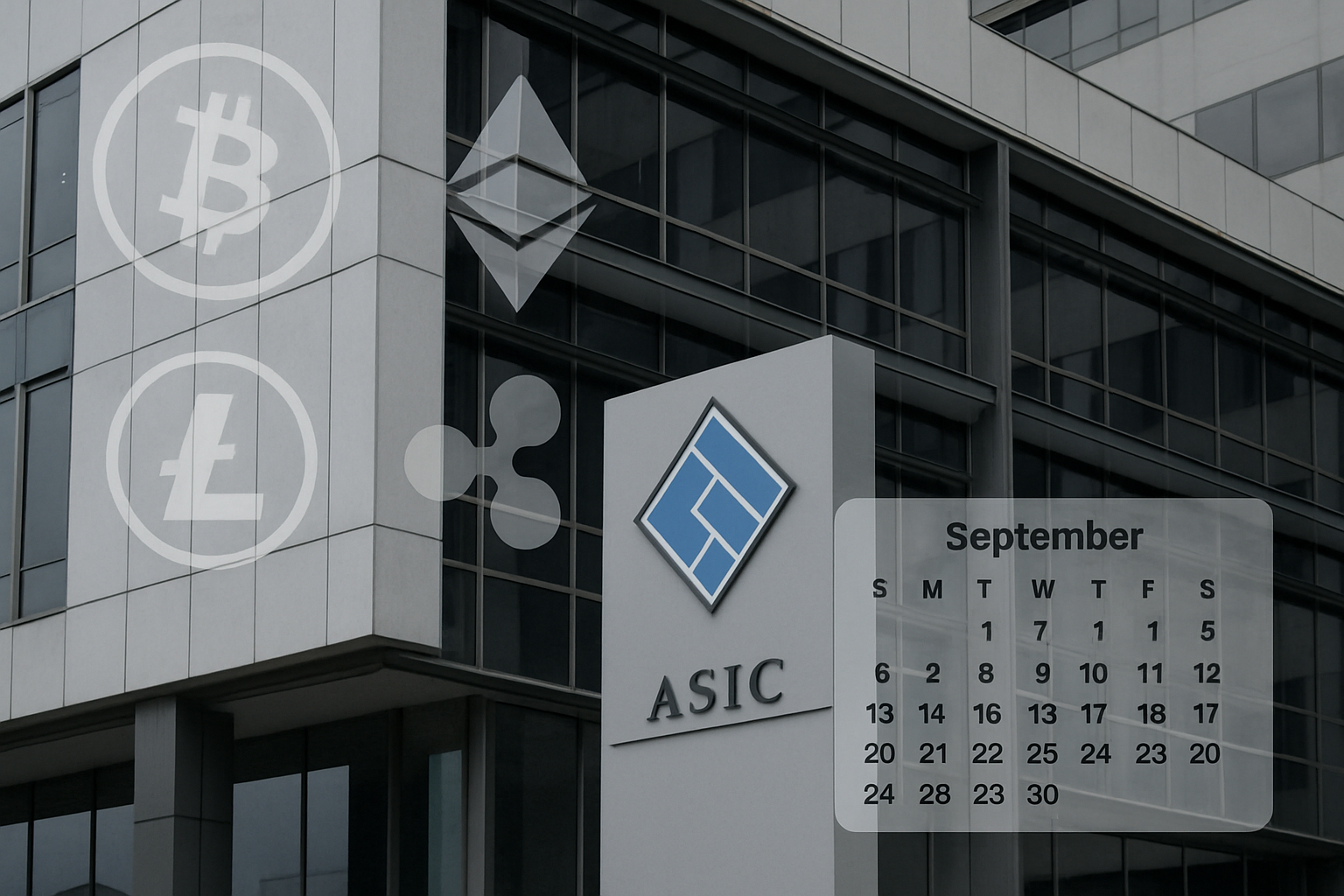
Australia’s financial markets regulator has delivered a blunt reminder to businesses that provide financial services involving crypto assets, saying the temporary enforcement relief that has allowed many firms to keep operating while they transition to the licensing regime will end at the close of business on September 30, 2026. The Australian Securities and Investments Commission said firms that still rely on the no action position must apply for or vary an Australian Financial Services licence, become authorised representatives, notify ASIC of intent to seek market or clearing licences, or begin an orderly wind down from October 1.
What ASIC is telling the industry
ASIC’s notice emphasises that the relief was transitional, and that failure to meet the conditions of the no action letter after September 30 risks breaches of financial services law that carry civil and criminal penalties, including fines that may reach up to 10 per cent of annual turnover. The regulator noted it has received several dozen licensing applications since guidance on crypto as financial products was updated last year, and it has been working with firms to support an orderly shift into the licencing framework.
The regulator’s deadline covers a broad set of services and structures. Firms providing financial services in relation to stablecoins, wrapped tokens, tokenised securities, custody arrangements and other digital asset products that meet the legal definitions are all within scope, unless they have already secured the right authorisations or otherwise satisfied the conditions of ASIC’s no action position.
Why the deadline matters now
Australia passed the Corporations Amendment that creates a dedicated Digital Assets Framework earlier in 2026, but the statutory regime does not commence until April 9, 2027. That means ASIC’s current licensing pathway and its transitional relief are the immediate mechanisms through which the regulator expects to bring the market into line with existing law while it prepares the new regime’s implementation materials.
For many operators the September 30 cut off is a practical trigger. Firms still without appropriate authorisations face three stark choices: complete an Australian Financial Services licence application or variation, arrange to operate under an authorised representative or an intermediary authorisation with an AFS licence holder, or begin a controlled wind down to avoid unintentionally breaching the law. The choice will affect not only market access but also the ability to hold client assets, offer yield products and run discretionary services to Australian retail and wholesale clients.
Industry reaction and next steps
Market commentators and law firms tracking the reforms say the deadline has accelerated urgent compliance work. Legal and advisory firms that specialise in financial services have been publishing guidance and checklists in recent weeks, warning firms to clarify whether their products are financial products under existing law and to prepare detailed licence applications or formal authorisation arrangements without delay.
ASIC itself says it has been pragmatic in applying transitional relief, and that the extension process and previous clarifications were intended to support an orderly transition. The regulator also reiterated that the full Digital Assets Framework will take effect from April 2027, and that it will continue industry engagement while releasing regulatory guides and standards that accompany the new statutory rules.
What operators should be doing this week
Practically, firms that believe they remain covered by ASIC’s no action position should immediately check they have lodged an application or variation that meets the terms of the class no action letter, or formalised an authorised representative or intermediary arrangement by September 30. Firms that are unsure whether their token or service is a financial product should seek urgent legal advice and, if necessary, contact ASIC to discuss their circumstances.
For Australians who hold crypto through local platforms, the end of transitional relief is unlikely to change day to day access instantly. However, some noncompliant firms could be forced to pause services or leave the market if they cannot meet licensing conditions quickly, and that could affect trading, custody and staking options offered locally.
The regulator’s notice marks an immediate countdown for Australia’s digital asset industry, and signals that the period of informal regulatory tolerance is about to close. Firms that have not yet completed the licensing pathway face a short window to act in order to avoid enforcement risk and potential disruption for customers.